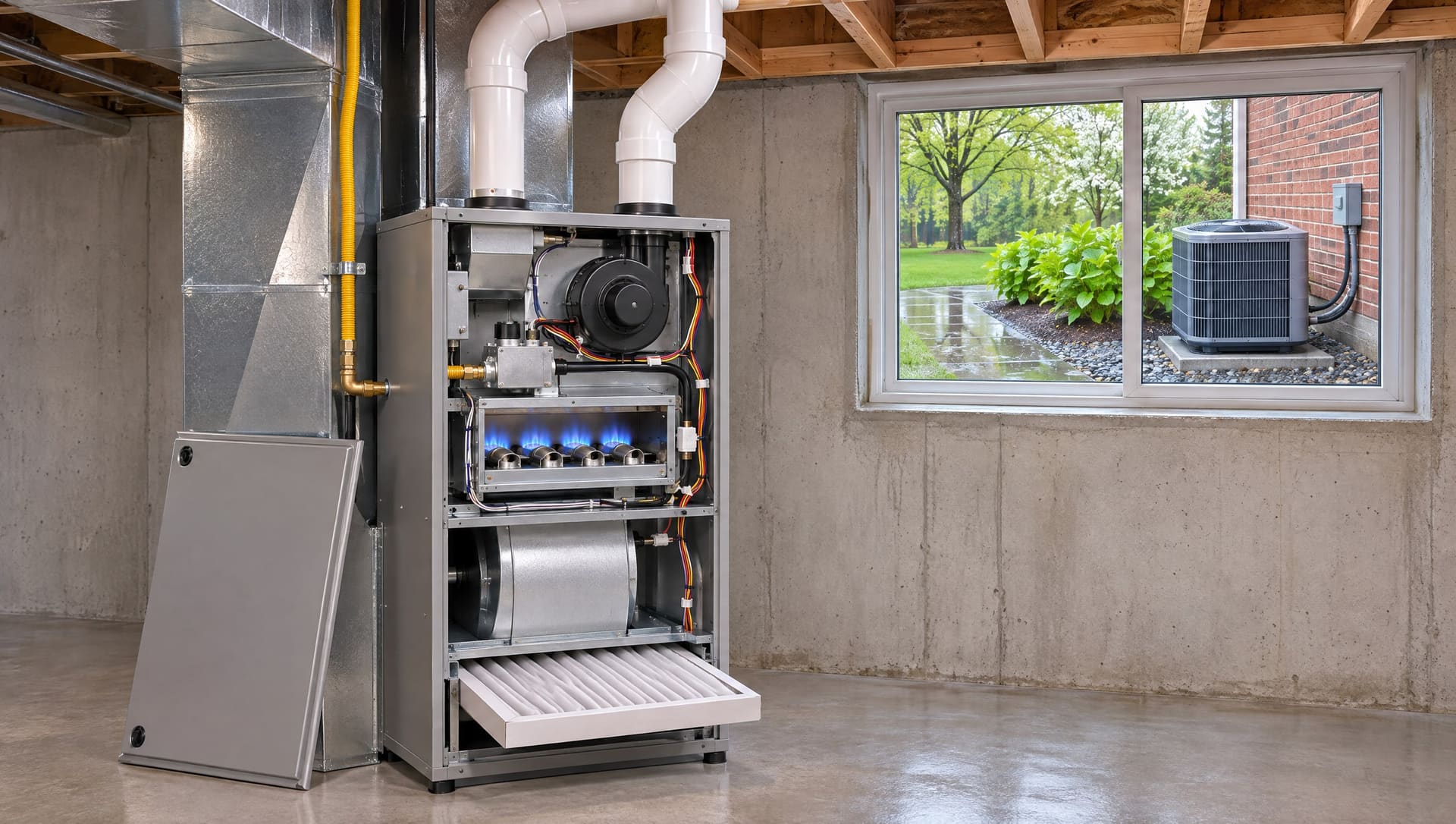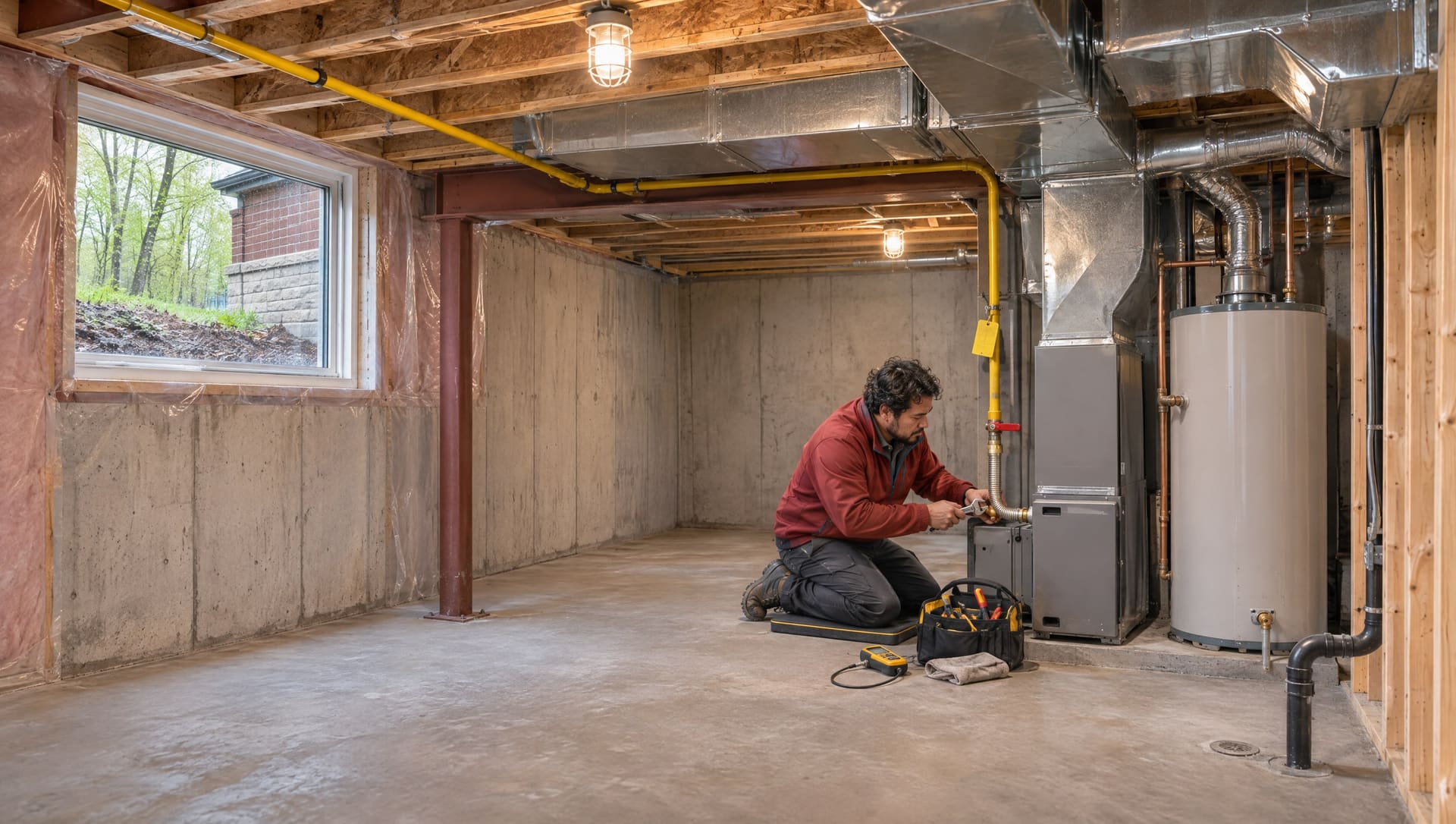
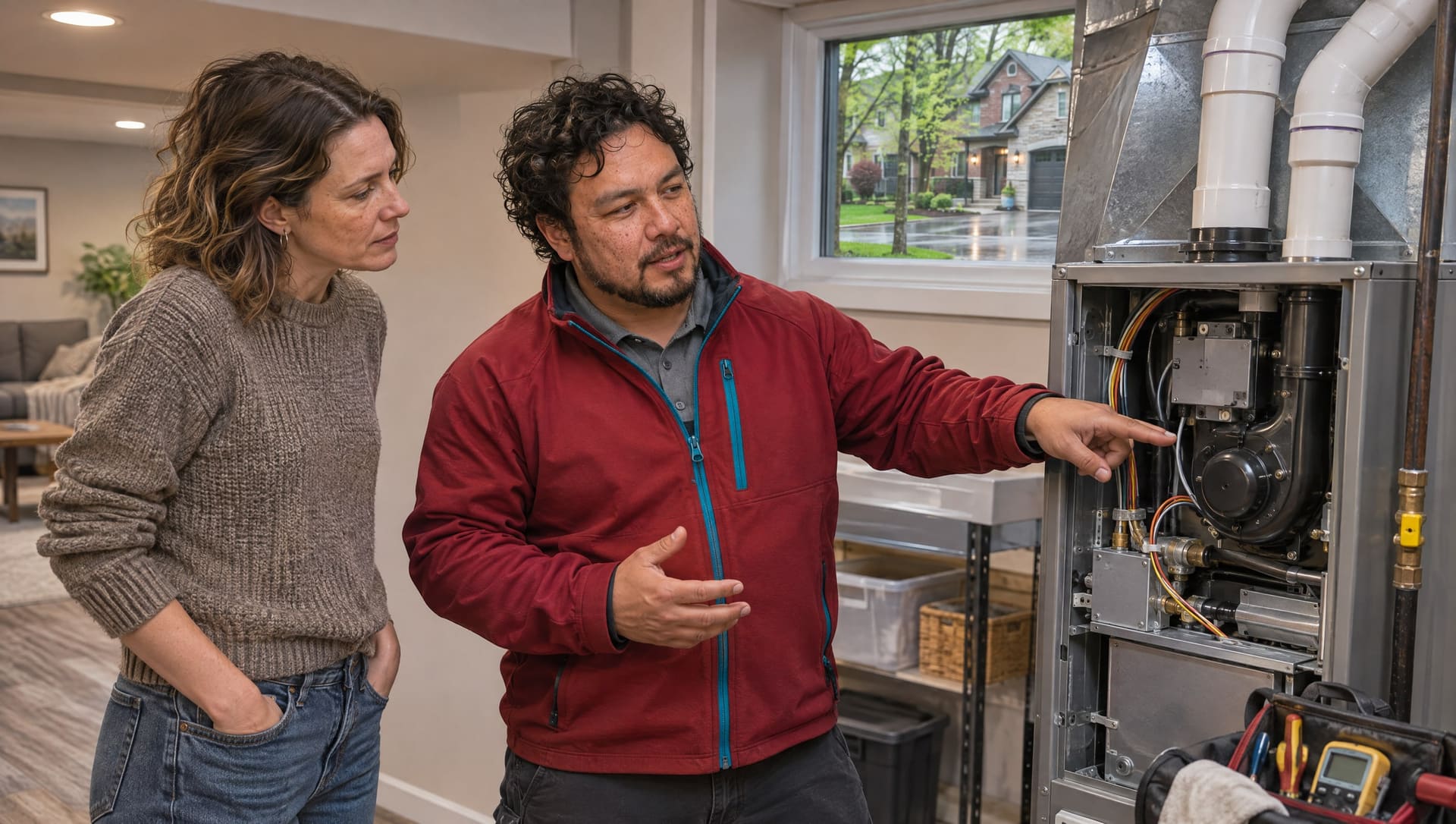
Start by finding out what you already have. Go down to the basement or crawl space and look for three things: what heats the house (a furnace, a boiler, electric baseboards or a mix), whether there is ductwork and how big it is, and how the system vents. That might be an old masonry chimney, two plastic pipes through the side wall, or nothing at all. With those answers you can rule out about half the options before anyone gives you a price.
In Innisfil, your answers depend mostly on when and how the house was built. The town has three broad waves of housing, and each one comes with its own heating questions.
What kind of furnace do most Ontario homes have?
Most Ontario houses with natural gas heat with a forced-air gas furnace. It burns gas, warms air across a heat exchanger and blows that air through ducts. Houses built from the 1990s onward usually have a high-efficiency condensing furnace that vents through the side wall in plastic pipe, with a central air conditioner sharing the same ducts.
In Innisfil, natural gas comes from Enbridge Gas. In February 2025 the Ontario Energy Board approved Enbridge's certificate for the whole town, and there is no other natural gas distributor here. Before you plan a gas furnace for an older or rural property, check that a gas line actually reaches your street.
What are the three most common types of HVAC systems?
For homes, they fall into three groups:
- Ducted forced air: a furnace for heat and a central air conditioner for cooling, sharing one set of ducts. It is the standard in newer subdivisions.
- Heat pumps: these move heat into the house in winter and out of it in summer. A ducted heat pump uses the furnace's ducts. A ductless system uses wall-mounted indoor heads linked to an outdoor unit by small refrigerant lines.
- Room-by-room or hydronic heat: electric baseboards, or a boiler sending hot water to radiators or in-floor tubing. Neither provides cooling, so homes with these systems often add ductless units or window units for summer.
A hybrid system combines the first two. A heat pump handles most of the year and a gas furnace takes over on the coldest days.
What suits an old hamlet house in Stroud, Churchill, Big Bay Point or Belle Ewart?
Innisfil's oldest houses are in its 19th-century settlements. Big Bay Point was settled in 1820, Stroud had the township's first school in 1838, Belle Ewart was formed in 1854, and Churchill grew up on the early road to Barrie. Houses of that age were built for wood or coal stoves or a gravity furnace, then converted to oil and later to gas.
That history tends to leave two problems:
- Ductwork that was added later and is often too small for a modern furnace, or for central air. A new furnace pushed through undersized ducts runs noisy, heats unevenly and wears out sooner. The duct system has to be measured along with the house.
- An old masonry chimney. A condensing furnace vents through the wall, so it no longer uses the chimney. If a gas water heater is left venting into that chimney on its own, the chimney may need a liner so it drafts safely.
For these homes, a high-efficiency gas furnace usually works well once the ducts and venting are sorted out. If the ducts can't be enlarged without opening plaster walls, a ductless heat pump in the rooms that need it can cover cooling and much of the heating.
What about a converted cottage or a Sandy Cove home with no ducts?
Innisfil started as a community of seasonal homes, and most of the cottages along the Lake Simcoe shore are now lived in year-round. Many post-war houses on Alcona's older cottage streets, and the modular and single detached homes in Sandy Cove, were built with electric baseboards or an oil furnace. They often have no ductwork and a crawl space instead of a basement.
That changes the decision. Adding a gas furnace means running new ducts, which can be awkward or impossible in a low crawl space. A ductless or cold-climate heat pump is often the more practical step. It adds cooling the house has never had, and the existing baseboards can stay as backup on the coldest nights. Grant and rebate programs for heat pumps change from year to year, so check what is currently offered before you commit. Some programs require an assessment before the work starts.
What do Alcona and Lefroy subdivision houses usually need?
Most of Innisfil's newer housing is in Alcona, which the Town's planning policies name as its Primary Settlement Area. More new homes are going up in Lefroy, Belle Ewart and Friday Harbour. These houses nearly all have a forced-air gas furnace and central air.
Here the question is usually when and how to replace the existing system. Builders tend to install the same equipment along a whole street, so it all reaches the end of its life at about the same time. The common faults are snow-blocked intake and exhaust pipes and failed condensate drains. For a house with sound ducts, replacing like for like with a well-sized furnace is often the simplest choice. Adding a heat pump in place of the old air conditioner to make a hybrid system is also worth pricing.
What is the best heating system to have in your house?
No single system is best for every house; it comes down to matching the system to the house and the climate. Innisfil winters are long. At Environment Canada's Barrie WPCC station, the 1981 to 2010 normals show 223.0 cm of snow a year, a January daily mean of -7.7 °C, 12.2 days a year colder than -20 °C and 4,253.7 heating degree days. Whatever you choose has to handle a long season and real cold snaps.
Summers are shorter, but they get hot. The same station averages a July daily high of 26.3 °C and 10.4 days a year above 30 °C, which is why many owners choose a system that cools as well as heats.
As a rough guide:
- Good ducts and gas on the street: a high-efficiency gas furnace, or a hybrid system.
- No ducts, or ducts that can't carry the load: a ductless or cold-climate heat pump, with existing baseboards kept as backup.
- Old house with converted heating: a gas furnace or heat pump, after the ducts and chimney have been checked.
What is the cheapest type of heating system in Canada?
"Cheapest" can mean two things, and they often point in opposite directions.
- Cheapest to install: electric baseboards cost little to put in, but they are usually among the most expensive ways to heat through a long winter.
- Cheapest to run: this depends on current gas and electricity rates and on how efficient the equipment is. A high-efficiency gas furnace and a cold-climate heat pump are both much more efficient than old oil or resistance heat. Which one costs less to run in your house depends on those rates and on how cold the winter gets.
To compare them fairly, ask for written prices on two options, with the installation cost and the expected running cost listed separately. If the water heater is part of the plan, check first whether it is a rental. Rental contracts can carry cancellation fees.
Who is allowed to install it, and what else should you check?
In Ontario, gas appliances are installed to the CSA B149.1 code, which is adopted under Ontario Regulation 212/01. On gas work: Work is performed by TSSA-certified gas technicians. On heat pump and air conditioning refrigerant work: Work is performed by 313A refrigeration and air conditioning mechanics. The guide who is allowed to do gas work explains this in more detail.
Two more things to check:
- Carbon monoxide alarms. The Ontario Fire Code requires a working carbon monoxide alarm next to each sleeping area in any home with a fuel-burning appliance, a fireplace or an attached garage.
- Building permits. The Town of Innisfil requires a building permit for adding a woodstove or wood fireplace. Furnace replacement isn't on its list, but if you are unsure, check with the Town's building department.
If you're weighing a new furnace against a heat pump for your house, see furnace installation and replacement.